
Specialist Dentistry
Multiple Implants
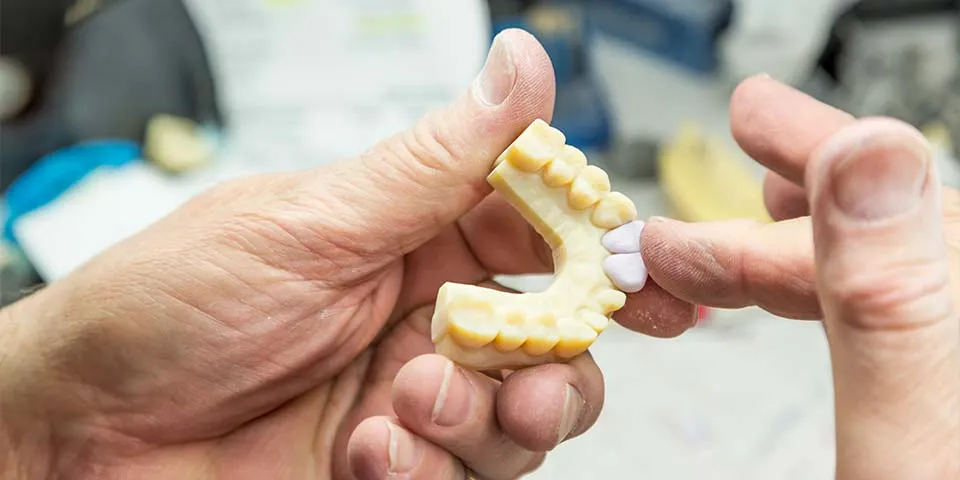
Easy-to-care for dental implants can also be used to replace several missing teeth with just one implant.
This also makes permanent dental implant therapy a more affordable solution for patients who have lost multiple teeth.
Carefully designed they can be a better solution than a tooth-supported bridge. Implants partially replace missing tooth roots by integrating with the jawbone that surrounds those roots, avoiding the loosening effect that arises from resorbed bone and the possible sinking of the jaw.
As with Single Tooth Implants, once a plan has been agreed, the necessary implants are placed in your jaw and a temporary bridge or crowns fitted on top. This is left to heal for three to six months. After the area has fully healed, your permanent crown or bridge will be fixed on top.
Considering dental implants?
Do you have problems with any of the following?
- Just one tooth?
- More than one tooth?
- All of your teeth?
- An existing implant?
- A loose denture?
Over the last year, we have continued to help hundreds of people regain their smile and confidence with dental implants.
Our helpful and friendly team understands what it’s like to have these problems and can answer all your questions. Whatever you need, we’ve got you covered at Shields.
Would you like to know more about dental implants?
Have a question about a treatment, need to book an appointment or would just like more information? Our treatment coordinators are available for free consultations in person at one of our conveniently located practices.
Frequently Asked Questions
There are 5 main signs that you might need implants:
- Missing teeth
- Cracked or broken teeth
- Problems eating or speaking
- Infected tooth or teeth
- Facial changes
You can indeed get a dental implant if:
- You have strong gums and sufficient bone in your jaw
- Your jawbone has reached full growth
- You don’t have any medical conditions that affect bone growth or healing
- You are willing to wait several months for the end results
Furthermore, your dentist will give you a full oral examination and take x-rays of your teeth and jaws to decide if a dental implant procedure is suitable for you.
Firstly, a dental implant (also called ‘tooth implant’) procedure can stretch over several months. Secondly, the procedure is as follows:
- Bone Grafting: If there has been any bone loss due to the missing tooth or missing teeth, bone grafting will be firstly carried out. This is done by introducing bone into the required area. The resulting bone acts as a scaffolding, thus causing more bone to regenerate around it. Also, it can take a few months for this to take place.
- The Implant: The dental surgeon will first give a local anaesthetic and maybe also sedation. A small hole is then drilled into the bone under the gum and the titanium implant is screwed in. The gum is then stitched up. The resulting implant mimics the root of the tooth and will hold the replacement tooth to be fitted. Lastly, a few months are required for the bone to fuse around the implant and fix it firmly in place.
- The Abutement: Once the bone and implant have fused, an abutment (the piece where the crown will eventually attach) is then fitted to the implant which extends above the gum line. Finally, when the gum heals around the abutment, the new tooth can be fixed on.
- The Crown: The new tooth or teeth are prepared by taking moulds of the existing teeth to get an idea of the size and shape of the crown(s). The colour of the crown(s) is/are also matched to the existing teeth.
After the process is completed, you may experience some temporary discomfort as follows:
- Gum and face swelling
- Pain around the implant
- Minor bleeding
- Bruised gums and skin
Your doctor will prescribe you with medication to treat these side-effects.
Your implant site will also need time to heal. To allow for this, you should avoid hard foods. Keep this up until your wound has healed.
The required aftercare involves brushing your teeth regularly and caring for your implants just as you would your natural teeth. Also, floss at least once a day and visit the dental hygienist twice per year. In addition, avoid excess caffeine, red wine and tobacco. Most importantly, hard foods such as boiled sweets can damage tooth implants and are best avoided.
The short answer is yes. However, this pain is usually easy to control with the use of local anaesthetic, antibiotics and pain killers. In the end, mild discomfort is what most people experience. However, the level of discomfort is highly subjective and depends on your overall health. The bottom line is that you should expect some pain. If your pain continues for longer than two weeks then it is time to seek further medical help.